
Learn the reason behind the move
Card Counting Practice for Speed and Concentration
Card counting practice starts with accuracy. Learn to keep a reliable running count before trying to deal faster, process pairs or hold a conversation at the same time.
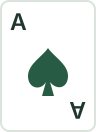
These exercises use Hi-Lo: 2–6 count as +1, 7–9 count as 0, and 10, jack, queen, king and ace count as −1. Practise at home with a standard deck or a training tool. You do not need to wager money to develop the skills.
Mental counting is different from manipulating cards or using electronic assistance. Rules governing casino access and assistance vary by jurisdiction; neither a universal right to count nor a casino's unrestricted right to exclude everyone should be assumed. Accurate counting also does not guarantee a profit.
One-card-at-a-time Hi-Lo drill
Start at zero. Add +1 for 2–6, zero for 7–9, and −1 for 10, J, Q, K or A. Keep the running count as each card appears. There are four of each rank in this shuffled 52-card practice deck; cards are not replaced.
No timer or wager. Use Enter to check your answer, then the Next card button. A wrong answer reveals the correct running total before you continue.
Build Accuracy With a Full Deck
- 20 low cards × +1
- +20
- 12 neutral cards × 0
- 0
- 20 high cards × −1
- −20
+20 + 0 − 20 = 0
Take a standard 52-card deck, remove the jokers and start at zero. Deal yourself a pile, updating the running count as each card appears. With Hi-Lo, the final count should be zero.
Shuffle and repeat at a comfortable pace. Keep a simple record of whether you finished correctly and where you lost track. Finishing at zero is a useful check, but two errors can cancel each other, so review individual decisions as well.
Work through repeated decks over several short sessions. Twenty attempts can give you a useful practice record; there is no requirement to complete them all at once or to improve within two or three days.
Once you can count consistently, start timing yourself. A deck in 30 seconds can be a personal speed target, not a promised result or proof that you are ready for casino play. Slow down when errors appear. The aim is for accurate updates to become familiar and less effortful.
Identify Cards by Their Visual Patterns
+1 · all ranks 2–6
0 · ranks 7–9
−1 · 10, J, Q, K and ace
With practice, familiar card layouts can help you recognise a rank quickly. Read the rank accurately before assigning its Hi-Lo value, rather than guessing from a blur or the approximate number of suit symbols.
Face cards and aces count as −1, but so does the numbered 10. Cards 7, 8 and 9 count as zero; only 2–6 count as +1. A vague rule such as ignoring cards with many dots will therefore produce errors.
Practise with clear cards first, then vary their orientation and comfortable viewing distance. Recognition is useful when cards are farther away, but poor visibility is a reason to acknowledge missing information, not invent a rank.
| Cards | Count change |
|---|---|
| 2, 3, 4, 5, 6 | +1 |
| 7, 8, 9 | 0 |
| 10, jack, queen, king, ace | −1 |
Picture the Updated Count in Your Mind
- Before the card
- +2
+2 − 1 = +1
Picture the updated count: +1.
At first, you may describe every step internally: “A jack is −1. Subtract one from the running count of 2. The count is now 1.” That can be a useful way to learn, even though it becomes slow when repeated for every card.
Try holding the updated number in mind instead. When a jack appears at a running count of +2, move directly to +1. You can picture the number or silently say the new total, whichever helps you stay accurate.
Introduce this gradually. The exercise is intended to shorten unnecessary mental narration, not to make you skip recognition or hide uncertainty about the count.
Process Two Cards at a Time
−1 + 1 = 0
The pair leaves your running count unchanged.
Next, practise dealing two cards together. Recognising their combined value can reduce the number of separate updates you need to make.
A king and a 3 cancel to zero in Hi-Lo. Instead of calculating −1 and then +1, recognise that the pair leaves the running count unchanged. Two low cards add +2, two high cards subtract 2, and two neutral cards leave it unchanged.
Blackjack hands begin with two cards, although those cards are normally dealt in separate passes around the table. Pair recognition is a practice technique, not a reason to overlook cards as they become visible.
Combine pair exercises with single-card drills so that later hits and dealer draws remain easy to follow. Faster times may follow, but keep checking the final count and any uncertain pairs.
Add Noise and Distractions to Your Practice
- +1
- 0
- +1
Quiet room → repeat with background conversation
Once you can maintain an accurate count in a quiet room, add one manageable distraction at home. Background conversation, music or a crowd recording can help you practise holding the count while other things happen.
Use a comfortable listening volume, whether through speakers or headphones. Loud or unpleasant audio is unnecessary. Compare your accuracy with and without the distraction before adding more difficulty.
You can also ask friends to deal a practice round while talking. Track every exposed card across the table, not just the cards in one hand. Keep the exercise separate from any real-money game so that practice does not create a reason to spend money.
If you lose the count, stop and reset rather than guessing. Take a break when concentration fades. You can build this skill without visiting a casino or finding a noisy party.
Hold a Conversation While Keeping the Count
Say “blackjack” while recognising the queen
+2 − 1 = +1
Talking while counting is another concentration exercise. Begin by saying “blackjack” aloud as you work through a deck, then try a simple conversation with a friend.
Repeating a word while updating a number may feel awkward at first, rather like patting your head while rubbing your stomach. Start slowly and check the result after each deck. Improvement comes at different speeds for different people.
Once that feels manageable, combine conversation with quiet background audio. Add only enough difficulty to identify what interrupts your accuracy, and return to the simpler exercise when necessary.
The aim is to divide attention reliably. A quiet player is not automatically counting, and ordinary mental counting should not be described as duping a dealer. This exercise does not guarantee that casino staff will permit continued play.
Extend Your Training With Blackjack Simulators
Player total: 12
Dealer upcard: 5
Strategy drill: stand
Four-to-eight decks, dealer stands on soft 17.
Training software can complement a physical deck by presenting cards consistently and giving feedback. Use the full-deck practice on this page for running-count work, and practise basic-strategy decisions separately with the strategy trainer.
QFIT's Casino Vérité Blackjack is a publisher-verified option for practice games and counting drills. QFIT also provides demo downloads. Check the publisher's current platform requirements and whether the exercises fit your goals before buying; owning software does not establish proficiency.
Choose exercises that distinguish running-count accuracy, remaining-deck estimation, true-count conversion and playing decisions. A fast full-deck count tests only part of the skill set.
Use software for training away from live casino play. For example, Nevada's NRS 465.075 prohibits specified devices, software and hardware intended to obtain a gaming advantage, including card-tracking assistance, subject to its stated exceptions. That is a Nevada rule, not a statement of the law in every jurisdiction.
Assess Your Skills at a Live Table
- +1
- 0
- 0
- +1
Taking your card counting practice into a casino is optional. A live table is not a required destination or a test you must pay to pass. You can continue developing the skills with a deck, friends and training software at home.
If you choose to visit a casino, observe only where the venue permits it and follow its procedures. Observation can help you compare a live game with your expectations without treating a wager as a training requirement. If you choose to play, set a spending limit beforehand and do not increase it to complete an exercise.
Notice whether you can recognise exposed cards at the actual dealing speed, maintain the running count through payouts and conversation, and identify when you have lost information. Also notice how you feel: distraction, fatigue or discomfort are useful reasons to stop and practise under easier conditions.
Establish the starting number of decks from the game information or staff rather than guessing it from the shoe alone. Between rounds, where the cards are visible, compare your estimate of the remaining decks with the starting pack and practise the running-count-to-true-count conversion mentally. An estimate is still an estimate; do not pretend to know cards you could not see.
The useful outcome is a clear account of what needs practice, not a winning session. Afterwards, record which tasks were difficult and recreate those challenges at home. Keep electronic training tools away from live casino play.
| Skill | What to assess |
|---|---|
| Card recognition | Could you identify every exposed rank without guessing? |
| Running count | Could you keep the total through draws, payouts and pauses? |
| Deck estimation | Could you estimate remaining decks from a known starting pack? |
| True count | Could you apply the correct divisor and rounding convention? |
| Concentration | Which interruptions caused uncertainty or fatigue? |
Recognise Changes in Staff Behaviour
Old shoe information
Freshly shuffled pack
Hi-Lo restarts at 0 after the shuffle
A dealer change, an early shuffle or a conversation with a staff member does not establish that someone suspects you of counting. Those events can be part of ordinary table operations, and you cannot reliably infer a staff member’s intention from a single change.
Pay attention to what actually changes. A shuffle ends the old shoe information, so restart the count under your system’s rules. If betting limits, entry conditions or other procedures are unclear, ask for an explanation before making another decision.
Stay calm and follow staff instructions. Do not turn an ambiguous interaction into a reason to make sudden wagers, chase losses or attempt to evade a restriction. If you are uncomfortable, take a break or end the visit.
No relaxed manner or counting technique guarantees continued access to a table. Treat staff behaviour as a practical part of the setting, not as a dependable signal that your method has succeeded or failed.
Keep Your Table Routine Natural
Position 1: tags cancel
Position 2: +1
Combined change: +1
A comfortable table routine can help you communicate clearly and pay attention. Ordinary conversation and a polite response to the dealer are enough; there is no need to perform a persona or force distractions into your play.
Use the accepted hand signals, leave face-up cards for the dealer to handle and make any permitted additional wager clear. If talking causes you to lose the count, acknowledge the gap and return to conversation drills at home rather than filling it in with a guess.
At home, practise following exposed cards in different arrangements so that you are not dependent on one visual layout. At a table, focus on counting each exposed card once. Changing your scanning direction for its own sake can create missed cards or double counting.
A natural routine does not guarantee that staff will overlook counting, and it does not override venue restrictions. The aim is accurate attention and clear conduct, with the option to stop whenever the setting no longer suits you.
